
 Posts
Posts


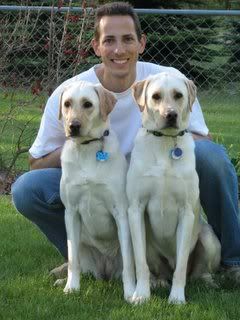
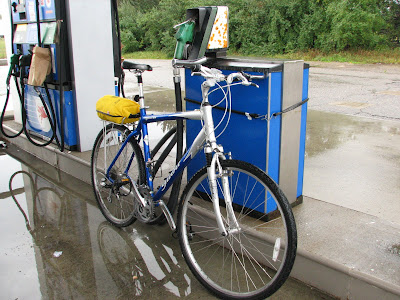
No worries about gas prices when running on human power!
For several years I've been hoping to go for an epic bike ride from my house in Lowell to my parents' house in Ann Arbor, a distance of roughly 120 miles. With my recovering hamstring preventing me from planning any running races, I thought that maybe this year I could squeeze in an all-day bike ride.
However, "real life" gets in the way as it often does and I wasn't able to put in enough training to prepare. Sure I could've pulled it off, but I figure that to do something like riding my bike across an entire state ought to be done right. For example, a decent road bike would help compared to my 6-year-old "comfort bike".
Yeah, that's what my Giant Cypress DX is called and it's since been "tricked out" with a new seat (twice), bar-end hand grips, new pedals and second-hand pedal clips, bottle rack, speedometer, rear rack, and a cheap bike computer. It has served me well over the years on the roads, mountain bike trails, and even in adventure races. But it's not a fast bike.
A few years ago I bought a 25-year-old Peugot road bike for $65 just to see what a road bike feels like. Despite being an old 10-speed I easily averaged a full 1 mph faster on my standard routes. That bike is now in need of repair so the Cypress is all I have, meaning that a 120-mile ride would take 10-12 hours including food stops whereas a nice road bike could shave a few hours off of that time.
Ready to ride despite the rain.
Instead I planned a ride that traveled 55 miles, starting near Lansing and finishing at my parents' house. Last Sunday Amanda dropped me off near Webbersville at the I-96 exit in a heavy, steady rain! I was standing in a two-inch deep puddle as I unloaded my bike from the car and got ready to go. Due to the weather I had to keep all of my gear in a dry-bag bungeed to the rack on my bike and I wore a rain jacket to stay warm. You can see what the weather was like in Amanda's video:
The first 15 miles of my ride were solo as I pedaled my way to Stockbridge where I would meet Dad. It took me about an hour despite a strong WNW crosswind on my southbound road and the steady rain blurring up my sunglasses. Believe it or not I found the glasses to be of help because they kept splashes and road grit out of my eyes, but also being polarized it really cut down the glare from the wet road.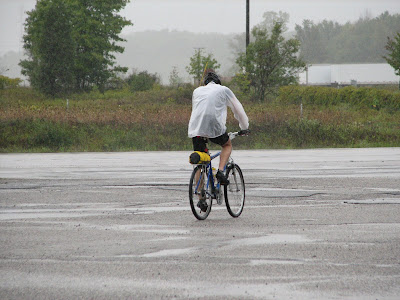
No frogs here, yet...
Worse than the wind and the rain were the frogs - dead ones. The shoulder of the road was littered with hundreds of dead frogs! I don't know why so many were trying to cross and getting hit and why they ended up on the shoulder but I was constantly weaving my tires among the slimy amphibian bodies, not wanting to get a taste of frog leg sushi kicked up into my mouth!
Finally I made it to Stockbridge and rendez-voused with my parents. Dad's raincoat was rather heavy - it's meant for field work, not cycling - so Mom offered him the $1 "emergency poncho" that she keeps in her car. He was quite pleased although the poncho went down to his knees and he just about fell over trying to hop on his bike when the plastic caught on his seat! Mom had to trim off a foot or so of plastic and after the obligatory photo, we were on our way.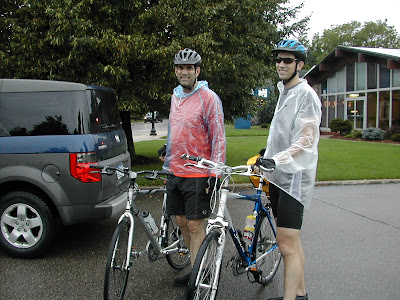
Dad and I are "waterproofed" prior to hitting the Lakelands Trail
Our route took advantage of the Lakelands Trail, a linear state park created as a Rails to Trails project. The first several miles of the trail were packed dirt that was rather rough in some areas due to horse traffic. We'd had several days of rain here in Michigan and the ground was wet but not soft. The bumpiness was pretty rough on me as Dad kept looking back wondering why I was lagging behind. I think his fresh legs had a bit more pep that mine after having ridden for an hour just to meet him!
Soon after starting down the trail the rain stopped and since the temperature was already 70 degrees even in the rain, we were plenty comfortable. It was actually splendid weather for a ride with overcast skies, a now NW breeze and warm air temps.
When my water bottle ran dry we stopped in Pinckney at a gas station to refill and we also chomped on some food: a Power Bar for Dad and some Clif Bloks for me. When planning the ride we talked about stopping here for food but we both were feeling very good and decided to just continue to our "dessert stop", a Dairy Queen in Hamburg.
For quite a while I was telling stories about the interesting politics I've been getting involved with in Lowell, only to be occasionally interrupted when Dad would point out one of "his" many projects in the area - a water tower, a subdivision, a boardwalk, and more - he's a land development civil engineer with lots of handiwork in Livingston County.
Suddenly Dad said "Oops!" It turns out he completely missed the turn for Dairy Queen! We'd been distracted by the conversation and since I've never been on the trail before, I was relying on his navigation. We only went about half a mile out of our way so it wasn't too bad, and when Dairy Queen is the destination you don't lose any motivation to get there.
At the DQ Dad got a large chocolate shake and I ordered a Blizzard with M&Ms, but asked if they could use chocolate ice cream instead of vanilla. The guy at the counter suggested their "Chocolate Extreme" flavor - chocolate ice cream with hot fudge syrup, fudge brownie chunks, and pieces of hard chocolate mixed in. Awesome! Yes, I love chocolate, but I also learned that even I have limits - a large Blizzard more than filled me up, but it was worth it.
Sitting at the outdoor table at DQ my dad whipped out his Blackberry and showed off some coolness, like how he can pull up a weather radar image. Days before our ride he had mentioned this and I teased him, saying "How would that help us on the ride? Are we going to see imminent rain and decide to pedal faster?"
We'd been riding precipitation-free for hours but looking at his Blackberry the radar image showed that a ton of rain was right upon us despite the bright but overcast skies. Wouldn't you know it... five minutes later as we pulled out of the DQ parking lot some big, fat drops of water started to fall! We could only laugh at the irony and besides, we'd been soaking wet since Stockbridge.
Soon we were at the end of Lakelands Trail and heading south on back roads near US-23 on our way home. The skies never did manage to open up - occasionally it would sprinkle a bit but then stop. Since the rain was coming from the NW and we were riding south I think we were keeping ahead of the weather.
Recharged with chocolate I was feeling pretty good but Dad was starting to tire out and we took a couple of extended water breaks on the side of the road to rest the legs. With about five miles to go our quads began to cramp up - both of us at the same time! Yet fortunately a couple miles later our legs relented and allowed us to finish our ride in comfort.
All smiles after dozens of miles.
But not in style - the first thing Mom said when we pulled into the driveway was "Wow, you're muddy!" Actually I didn't think it was that bad, but Mom insisted on a "rear-end view" photo nonetheless. Dad explained how only a two mile stretch of Warren Road was to blame - the rest of the entire route was paved or puddle-less dirt.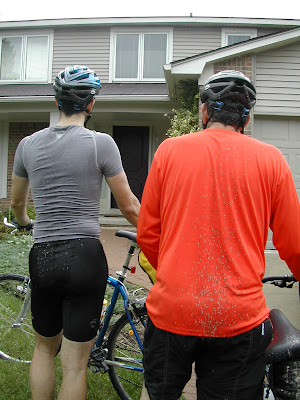
If Mom thinks this is "muddy", wait until we go mountain biking!
Dad and I also discovered that one or both of our bike computers isn't calibrated correctly - mine had logged a couple more miles than Dad's over the same course! I used MapMyRun to determine that my Webberville-to-Stockbridge solo ride was 15.2 "mapped" miles compared to 15.4 "computed" miles so it seems mine is a bit off. However, it's hard to say for sure about the rest of the ride since our double-back for missing Hamburg can only be guessed for distance.
All told my computer showed 55.3 miles, so assuming that it's off by 0.2 every 15.4, my total distance would be 54.6 - not a major error. I'll just call it 55 miles and be content.
Soon after getting home the "Blackberry rain" arrived and it began to pour cats and dogs. Two of the dogs were mine - Haven and Beacon arrived with Amanda and her parents, as did Ryan and Megan. We all (except the dogs) went to dinner at Red Robin where it rained even harder and the restaurant even lost power for a couple seconds before the backup kicked in! Perhaps it was a good day to not be riding 120 miles after all!
Overall the ride was a total blast and surprisingly "easy" if 50+ miles can ever be deemed easy. The route was pancake flat except for a few short hills between Hamburg and Ann Arbor and traffic on the non-trail roads was never a problem. My legs were sore for the next couple days but I never felt bonky or worn out. I'm already thinking about doing this again! But not this weekend. :)


(Now I've got that U2 song "Ultraviolet" stuck in my head!)
Once again Haven and I took to the streets of Lowell in the pre-dawn darkness for a 3-mile run. I run in the streets instead of on sidewalks because the latter can be very uneven, booby-trapped with low-hanging tree branches, or might not even exist in front of the older houses. The streets here are safer, day and night, but in darkness I want to be sure I'm visible.
Passive visibility - the type provided by reflective items - is certainly valuable but it requires someone else to shine a light on me. A car might not see me approaching on a perpendicular path, or another unlighted jogger or cyclist (I've seen both) could be a risk as well.
Active visibility - the type that provides its own light source - is what I recommend for running in the dark. Let me tell you about the three lights that Haven and I use when we're out before sunrise. The effect of these lights can be seen in the photos below:
Haven is wearing a blue-and-white Bling Bling Blinker, which I wrote about recently. It's a small but quite bright clip-on light that strobes between a blue and a white LED very rapidly. For good measure Haven also has a generic orange reflective sporting dog collar. Keeping us together is a Just-a-Cinch leash, which was designed with built-in reflective piping and I reviewed it here.
On my head is a Princeton Tec EOS headlamp that I originally purchased for adventure racing. It runs on three AAA batteries for about 1-2 hours on maximum brightness, which will give you good visibility 100 feet ahead of you and will illuminate reflective items (e.g. street signs) about 150 yards away. It has three brightness settings; in the photo you're seeing the dimmest setting so that I don't blow out the camera. It can last for many, many hours on the dim setting, but I always use the brightest and use rechargeable batteries. This headlamp is simple and comfortable and even waterproof! I can attest to that after falling overboard during a 4:00am canoe leg down an obstacle-ridden river... what a way to start a 15-hour race!
The red light you see on the back of my head is a simple Fun Source Safety Light clipped to the headband of my headlamp. This serves as my "tail light" for anyone approaching from behind. I don't think it's waterproof but it survived my dunking that I described above! I've used it for two years and haven't had to change the batteries yet.
Some of these items are cheap. The Bling Bling Blinker and the Fun Source Safety Light were $5 each. The Just-a-Cinch leash retails for $20 but I bought that more for utility than visibility. The Princeton Tec EOS headlamp set me back $40 (plus another $25 for batteries and a charger) but it's well worth it - the headlamp is the most important item to have when running in darkness. Why? Because it'll show me the cracks I'm about to trip over, the ice I'm about to slip on, and the people walking nearby that otherwise look like shadows. Plus it grabs the attention of motorists when you point the beam right into their windshield.
In fact, the first time I ran with Haven in the dark I had nothing special except the headlamp. When cars approached, I would face the beam towards the car, then point it down at Haven so they were aware I had a dog with me. Now that she's illuminated, I don't have to do that but having a powerful, directable beam is quite useful.
Ideally I'd like to have some reflective clothing - most of my running garments are the cheap kind, but the good ones usually have some reflective elements built right in.
Come to think of it, running in the dark can be just as safe as running in the daylight. First of all, there's less traffic in the wee hours. More importantly, an actively illuminated runner is very eye-catching at night - think of how often you notice the guy wearing blinking lights in the dark as you drive to work versus the average daytime runner. So yes, it can be very safe running in the dark if you choose it to be. Best of all, you get to enjoy the stillness and solitude of running without the sun!
Yes, I dream of being able to run a 3-hour marathon, when I'm conscious at least. When I'm sleeping, apparently I have much more fanciful marathon dreams, like this recent one...
My dream began at the starting line of the Grand Rapids Marathon but I wasn't expecting a fast time - I was just running to have fun. It's a bright, clear, sunny, warm day and I'm just cruisin' along. At the 8-mile mark I check my watch and see that I'm on a 3-hour pace and still feeling strong! But I knew this race wouldn't be fast so I didn't get my hopes up; besides, this marathon was advertised as an adventure race.
Soon I find out why - I'm running through a beer tent during the Oktoberfest in Munich! I distinctly remember the giant, sky-blue and white striped circus-like tent full of very happy patrons all offering me a stein of beer. I kept saying "Nur Wasser, bitte!" ("Only water, please!") but none of them had water. So I pressed on.
Next I was running along the banks of Plum Creek... yes, the same Plum Creek of Laura Ingalls Wilder fame. The course ran us through her family's old dugout home. Immediately after that we were running through the Big Woods, you guessed it, taking a tour of her log cabin. I even had to climb the ladder into the loft, then back down, as part of the course.
The marathon continued to the great plains of Africa, where I ran through a humongous wood-frame tent with translucent canvas walls. It was easily the size of a large farm barn, if not larger, yet the interior looked like the inside of a zeppelin with catwalks everywhere. Again I had to climb a ladder, this one about 40 feet high, and then run along the rafters! Yet I wasn't nervous at all; in fact I was enjoying it and made a point to remember to thank the race director. Sleeping on panels of canvas all over the barn-tent were native tribal African couples. I ran out of the barn-tent and ran a big lap around an open field, then back through the barn-tent. This time through one of the sleeping couples were making love right in front of me! They ignored me and I did my best to ignore them, too.
My race was nearing the end but there was one more building to traverse - an old Spanish monastery somewhere on the California coast. It had stucco walls and mostly ceramic tiles on the roof, except for the tower which had an old, rotting, wooden roof. Once again I scaled a very long ladder to reach the tower roof and became nervous about having to run across the roof - it didn't look very sound. A monk appeared wearing a nun's outfit and coaxed me to come across, insisting it was safe. I took a few steps and my left foot suddenly crashed through! The monk-nun grabbed my hand and helped me the rest of the way across. As I climbed down the ladder on the other side I looked at my watch and saw 5:30 elapsed time, and figured I'd finish within 6 hours. I was quite satisfied with this time and thought to myself "This was quite an adventurous race! I'll sign up again next year."
The end.
Triathlons are probably the most popular multi-sport event out there. I've never tried one, although I have completed a few adventure races. One thing that has intrigued me over the years is that most triathletes I know are cyclists who converted to triathlons, or for whom cycling is their strongest discipline. There are a few runners who dabble in triathlons but I don't know many swimmers gravitating to the sport.
Why? At first I assumed that the meticulousness required of cyclists to maintain their bikes is an attitude well-suited to triathlons - you have to keep lots of gear in order. Maybe this is why most adventure racers seem to hail from backgrounds in either mountain biking or rustic camping.
Seeking a better explanation, I started by comparing the lengths of disciplines involved with triathlons, specifically the iron-distance variety: 2.4 mile swim, 112 mile bike, 26.2 mile run. Is running a marathon equivalent to swimming less than a tenth of that distance? Let's examine a hypothetical situation...
Three buddies are training regularly for Ironman Hawaii. Each has a background as a single-sport athlete in each discipline. Sam is a Swimmer, Bob is a Biker, and Rick is a Runner. As a result, each is 10% faster than average in their specialty; in the other two disciplines they are average. In theory, they should each finish at the same time, right? Let's look at the results for the 2006 Ironman in Kona.
First up was the swim leg - average time was 1:16, which is when Bob and Rick came out of the water. Sam was 10% faster, so he finished at about 1:08.
Next was the bike leg - average time was 5:47, good for Sam and Rick. Bob's 10% advantage has him finishing in 5:12.
Finally the run leg - average time was 4:10, which is what Sam and Bob ran. Rick was 10% faster and finished in 3:45.
(We'll assume that all three of them were average in transition times at 4:30 per transition, 9 minutes total.)
You can probably see where this is going... Bob was the first of the buddies to finish, crossing the line at 10:47 and putting him 4.6% ahead of the average overall finishing time of 11:18. Rick finished 10 minutes later at 10:57, 3.1% above average overall. Then "straggled" in Sam at 11:14, his swimming prowess placing him just 0.6% above average overall.
No wonder most triathletes are primarily cyclists - they get the most bang for the buck! Swimmers get the shaft. For this reason some have proposed re-scaling the distances so that each discipline takes a similar amount of time, based on single-sport athletes' records for each. This has been called an "equilateral triathlon". For comparison, a traditional iron-distance swim/bike/run is 2.4/112.0/26.2 (in miles) while an "equilateral" iron-distance triathlon would sport distances of 7.5/60.0/26.2, where a world-class single-sport athlete could finish their respective discipline in just over 2 hours. Quite a difference!
However, is that really a fair comparison? What's more difficult: swimming 2 hours, cycling 2 hours, or running 2 hours? Maybe Sam's 10% swimming advantage only saves him 8 minutes of time, but also saves him proportionally more energy so that in theory he could do the next two legs a little above average, while Bob's 35 minute savings on the efficient bicycle doesn't gain him much extra energy over other racers.
Here's how I'd do it: Find out how many calories the average world-class marathoner burns over 26.2 miles. Then determine swimming and cycling distances where athletes of similar caliber would burn the same number of calories. That way competitors would strive for equal skill and efficiency among all disciplines in order to maximize their overall endurance. I believe that such an "energy distance" triathlon would be truly unbiased!
It's a great time to be a fan of endurance sports! Right now two sports - adventure racing and road cycling - are putting on their biggest events of the year. The best adventure racers in the world are just finishing up their premier event, the Primal Quest, hosted in Utah this year. As the Primal Quest comes to a close, cycling's signature Tour de France race is kicking off in Europe. Both events take several days to complete, which may be too slow for TV but it's a great type of race to follow during the day via the internet - day after day of wondering what it would be like to undertake such an endeavor.
The Tour de France (TdF) is a stage race, which means competitors race a given segment of the course each day and they add up the total time required to complete each leg. The TdF covers over 2,200 miles during the course of 23 days (including two rest days of no racing) winding through the mountains, farm fields, and towns of France and Germany. While I'm not an avid road cyclist, I find the strategy and tension to be captivating. It's a lot like watching soccer or NASCAR - extended periods of little obvious action during which teams are intensely trying to set themselves up to capitalize on a sudden opportunity.
Much more exciting and even inspiring to me is the Primal Quest (PQ), which is a continuous expedition - the race never stops. When to sleep, and how much sleep to get, is a key strategic factor in every team's success (or lack thereof). It is this event that has left me more amazed and in awe than any other sporting event. The PQ covers 500 miles comprising varied disciplines such as trekking, kayaking, mountain biking, and mountain climbing. The winning team finished in just over six days, and the slowest teams will take up to ten days.
While strategy plays a huge role in the TdF, the strategic planning of the PQ is many times greater in scope. Not only are the racers pushing themselves physically, but also cognitively as they battle fatigue, dehydration, malnourishment, overheating, and sleep deprivation without a chance to recover until they finish. It gives new meaning to the word "perseverance", or even "survival". If it wasn't enough to be physically exhausted and mentally burned out, racers have to remain emotionally upbeat and continue to work well together.
What really intrigues me about expedition-length races (covering several days) is the amount of personal drive and will power required just to finish the event. You and your team of four, on your own in the middle of nowhere, in the middle of the night, hoping that you planned and trained appropriately for the weather, the terrain, and your mental state. Someday I would LOVE to compete in PQ or a similar expedition; in fact there's a great one here in Michigan put on by Infiterra Sports.
I'm probably not prepared yet to complete an expedition race, but how do I know for sure? A few of my training buddies have completed the Michigan Coast to Coast so I know it's well within my realm of possibility. But what more am I capable of? In 9th grade I loved running but didn't join the cross country team because I didn't think I could run three miles; I'd never run farther than one at the time. Then as a high school senior I did finally join cross country and even though I went on training runs up to ten miles long, I felt that a marathon was well beyond my abilities. During college I marvelled at the Eco Challenge races but felt that I could never do it. Even when my neighbor during my last year of college was recruited by an Eco Challenge team, it never occurred to me that such a challenge was within my grasp.
After college I stopped running for about five years, but resumed running a couple years ago. Last year I ran my first marathon and finished my first adventure race (an 8-hour sprint). I used to think three miles was impossible for me, and then I thought a marathon was impossible. Those were enough to make me wonder, just how much is possible? This fall I plan to complete a 50 mile trail run... holy cow, can I really run 50 miles? There's only one way to find out! Following the PQ and TdF will help to inspire my desire to ENDURE, to PERSEVERE, and FINISH an event that at one point in my life I used to consider impossible for myself. Whether or not I finish it's going to be painful, but worth the effort - at least I'll know just how far I can go.

One of the highlights of Lowell is the Kent County Fairgrounds. The main event each year is the Kent County Youth Fair, but this beautiful site at the corner of the Flat River and Grand River has numerous other uses. There are annual events such as the Bluegrass Festival, Pow Wow, and even a hovercraft club convened on the grounds. The fairgrounds also host facilities for the high school crew team, youth football and t-ball, and your basic camping, boating and fishing. I often visit the fairgrounds, but usually not for the above reasons - instead, you'll find me running on the dirt track around the football field.
Whenever a major event is in town, the fairgrounds are packed with people. However, during the week the place is quite empty and if I feel like doing some speed training, the track is a great escape. It's not a spiffy, rubber-surfaced track like at most high schools; rather, it's just a 1/4-mile ring of hard-packed dirt with weeds growing on the front stretch. Best of all, it's just a mile from my house!
All day at work I was in quite the antsy running mood - I felt like burning some energy. It didn't help that the world's premeir adventure race, the Primal Quest, is going on right now. I kept checking the leaderboard and tried to imagine what it would feel like to experience such an epic physical and mental challenge. Alas, I was spectating from the vantage point of my drab beige cubicle, so I was more than ready to run when I got home.
It was a good point in my training routine for some speed work. Haven absolutely LOVES to go running with me, so I laced up my shoes and leashed up my dog and out the door we went. Our one-mile warm up jog took us through historic downtown Lowell. Haven is obedient enough now that I was able to let her off leash, especially having the entire track to ourselves. I started off by running one fast lap and Haven simply kept pace just a foot behind my left heel. Next lap was a slow recovery jog so Haven took the liberty to explore our surroundings a bit. But each time I ran a fast lap, she stuck to my heel all the way around the loop.
After a few laps Haven started getting hot and tried to linger in any shade she could find. One time she ignored my whistled command to "come" just long enough to grab a drink from the nearby river! So we rested five minutes in the shade, then began doing wind sprints (well, as much of a "sprint" as I could muster) at which point Amanda arrived with Beacon. While Beacon does enjoy running, he's not nearly in love with it as Haven. Beacon's thing is frisbee fetch.
Amanda waited with Beacon on leash while I finished my last couple sprints and another fast lap around the track with Haven. Haven and I then gulped down some much needed water before putting the leash on Haven and setting Beacon free. Yes, we brought his frisbee and we played fetch with him until he was desperate for water, too. Now that everyone was exhausted, we ordered a $5 pizza to pick up for dinner on the way home. Both dogs have been sleeping ever since!
Last weekend Amanda and I volunteered at an adventure race at Ionia State Rec Area. The race is called the GRAAR Spring Adventure Challenge, a 6-hour race geared towards beginners. GRAAR is the Grand Rapids Area Adventure Racing group, the local AR club that I occasionally train with. One of the club's founders, Mike, was a one-man race director, doing nearly all of the organization and planning by himself. Pretty impressive, and the race went smoothly! My job was to help out at the canoe put-in with another GRAAR member plus two of Mike's sisters. We helped unload the 40 aluminum canoes, lined them up by the launch area on the river, and instructed all racers to "park your bikes in the woods, grab paddles and life jackets, and don't forget to punch your passport". During the canoe unloading while holding a canoe over my head, the guy on the other end twisted it the opposite way I was expecting, resulting in me falling to the ground with the canoe landing on top of me! I was OK, just a bruised knee as it turned out. We had great weather for the race - in the 50s - and of course there was pizza at the post-race awards ceremony! If anyone wants to try adventure racing, this is the event to get your feet wet (both figuratively and literally!)
This weekend we adopted out our foster dog. We've been going thru foster dogs like runny nose goes thru kleenexes - you can read all about them on Amanda's site. Down to just two dogs, I decided to let them have some fun and come running with me. This week's training plan was a 20+ miler and neither dog has gone over 14 miles before. I didn't feel like pounding my joints on pavement for such a long distance, so I figured out a good trail run. My usual route on the NCT near home is an out-and-back that covers 11.6 miles, which I've done with the dogs before. This time I did it with both dogs - I ran out and back with Beacon, and upon returning home I switched dogs and went out and back again, this time with Haven. Boy did they get tired, but I think I was the worst for wear! 23.2 miles, just 3 short of a marathon, and entirely on hilly, muddy trails. Once finished, I quickly showered and then took a nap on the floor for half an hour! Then Amanda and I went out to Pizza Hut since we earned it. Oh yeah, during my run Amanda went out and ran, too - she ran one mile, walked a half mile, ran another mile, and walked a final half mile for a total workout of 3 miles. It was the first time she's ever run two miles in one day in her entire life!
Today I went for my weekly "long run", although usually I run those on a weekend. It was just 30 degrees F and somewhat windy, so I wore long underwear and my long trekking pants. I also carried my hydration pack with 2.5L of Accelerade, which I was trying for the first time. My legs feel pretty good so maybe that stuff works, but it sure tastes nasty!
I set out from home and headed for Seidman Park, since Amanda was going to meet me there so that she could try some of the orienteering course that I had run on Sunday. It was an 11.4 mile run out to the park. The first four miles I felt awfully slow, but then I found my groove and ran a nice, steady ten minute pace all the way until mile 10, where I called Amanda for her cue to suit up and drive out to meet me. After I got off the phone my legs felt rather tired (I walked while talking) and it didn't help that the last 1.5 miles were all uphill! But I finished in 2:16, not too bad for a cold, windy day.
Amanda showed up about five minutes later and we each ate a stick of string cheese while I changed into my hiking shoes and put on a coat. When I ran the o-course (orienteering course) two days earlier, orange and white flags marked each point. Those markers were only there for the GRAAR event, however, so there would be no flags today. The plan was for Amanda to carry the map and compass and do ALL of the navigation while I tagged and along and merely verified that she had found the correct location where the flags used to be. Amanda loves to navigate with the compass and keep it simple - follow the bearing. She was walking pretty fast and my 11.4-mile-old legs were struggling to keep up. Sure enough Amanda hit every CP right on except for one, where she missed by only 50 feet. She was quick to point out that she nailed CP2, which my team had struggled to find earlier!
After an hour we had found the first five CPs and were getting hungry, so we nav'ed back to the parking lot and headed out for lunch at Noodles & Co. Mmmmm!!! I had leftovers so I can eat that when Amanda eats her leftover chinese food from dinner last night near Kalamazoo with friends.