
 Posts
Posts


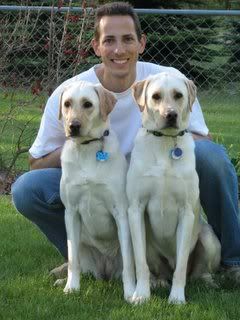
Saturday my parents drove here from Ann Arbor to take Amanda out for her birthday dinner. We did far more than that, however! A little after 9am we meet them at Grandma's pasture to go hiking. Dad brought along Uncle Bob while Amanda and I brought along the dogs. There wasn't any real purpose to the hike - we just started walking and whenever we thought of something interesting to check out, we headed in that direction.

First was passed through Tarzan's Jungle (named by all the grandkids when we were very young), a dark, tree-lined stretch of two-track with a mucky stream beside it. As we exited the "jungle" Beacon spotted three deer about 200 yards away and he took off like a Navy jet catapulted off an aircraft carrier! Haven didn't notice and by the time I got her attention pointed in the right direction, she was 100 yards behind.

Those three deer saw Beacon coming and bounded away easily, but out of sight to the right were five more deer that neither saw Beacon, nor did Beacon see them until he was right upon them! The deer bolted in the direction of their herd-mates and Beacon was right in the middle, getting within five feet of one deer with two more behind Beacon! Alas, poor Beaks, the deer were too fast. Haven got there just in time to make a show of giving chase. After making sure no more deer were hiding nearby, Haven and Beacon returned to us - very tired and very happy.

We hiked past our woodpiles from last week's lumberjacking then maneuvered among the long rows of pine trees, following the many highways paved by deer hooves. There were plenty of turkey tracks to be found as well, and finally we caught up to them after about 90 minutes. Haven and Beacon ran in pursuit as we watched the clumsy birds crash among the tree branches trying to fly away. The dogs were so tired by now that their chase only lasted about a minute!

Lastly we trekked through a marshy area of the property that we usually don't venture into because it's usually rather wet and ill-suited for vehicles. It's a nice setting back there with occasional clearings and stands of thornapple trees - quite different than other parts of the pasture. After chatting briefly with Bob and Therese (and Gabe) we headed over to Grandma's (dad's mom) house to go over some WWII information about Grandpa.
Dad and Mom are compiling some info about Grandpa's military service for a local historical group and they wanted to let Grandma check it over for accuracy, etc. They also wrote up stories for Grandma's four brothers, each of whom served in WWII with a different branch of the military: one each in the Army (Air Corps), the Marines, the Navy, and the Coast Guard. Grandpa himself was in the Navy as a mechanic, and Grandma worked at a factory building ailerons for aircraft. As Grandma put it: "After Pearl Harbor, everybody supported the war effort. You didn't worry much about how it affected your life. We just did what needed to be done."
We continued to discuss life during a war, then and now. Mom asked how 9/11 compared to Pearl Harbor. Grandma explained that they were similar, but noted that "nothing really changed" in our quality of life after 9/11. During WWII there were gas rations; for example if Grandma and her friends wanted to go hang out, they had to find someone with enough extra gas rations and pile into her car. There were collections of surplus metal, war bonds to purchase, and everyone's job converted to supporting the war. Grandma's factory where she worked stopped making springs and started making ailerons. Grandpa joined the Navy.
Speaking of which, Grandma noted that her parents were unable to attend ANY of their five children's weddings! She took the train to San Diego to marry Grandpa while he was stationed out there. Her four brothers also married far from home; the closest was a few hundred miles away and her parents didn't have the gas rations available to attend "so they just couldn't go - that's the way it was" says Grandma.
As we found out later, that's the way it was for my other grandma, Grammy. Spur of the moment we decided to pay a visit to my mom's mom following lunch at a deli in Ada. It didn't take long to start looking through old photos and we soon found a wedding photo of Grammy and Grampy. She also traveled west, to Los Angeles, to marry my grandfather while he was on duty out there. Ironically, both sets of my grandparents got married in California despite living in Michigan all their lives! That was life during WWII. They also directly supported the war - Grampy taught navigation using Link Trainers while Grammy installed hydraulic lines in bomber cockpits. Was anyone not involved with WWII during that era?
Grammy also showed us a photo of her grandparents and other relatives of similar age. I don't remember when it was taken but those people were probably all born between 1850 and 1875! One of them is related to Commodore Matthew Perry, but I forget exactly the relation; I do know that I'm not a direct descendant of him, but he's somewhere in my family tree.
I forgot to mention that on the way to Grammy's house we took a little tour of Grand Rapids, driving by: a house that Amanda and I almost bought; the first house I lived in, also the first house my parents bought together; the first house my dad lived in after college, right on the Grand River; and a few other curiosities.
Finally we made it back home where we played a few rounds of a board game called Compatibility, where each player has a deck of cards with photos on them. A word is read (e.g. "retirement") and then you have to select, in secret, 2-5 photos that you feel best represent that word. You play with a partner, so the object is to pick the same photos as they do. So for "retirement" do you pick the photo of the old man, or the dollar sign, or the sunset, or the card that simply contains the word "happy"? A very fun game. Amanda and I managed to win both rounds by just one space on the game board!


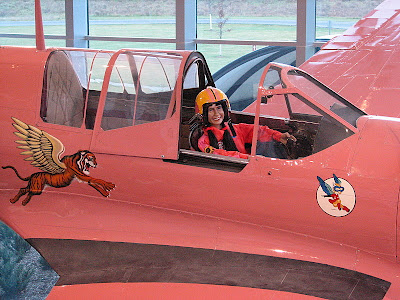
Yep, you can find flying tigers (on pink WWII fighters, no less!) at the Kalamazoo Air Zoo! Amanda and I visited this aviation museum yesterday and we thoroughly enjoyed it. They have several real aircraft plus many more replicas and mock-ups. While the entire history of flight is covered, the emphasis is on World War II aviation. Some highlights...
Missions Theater - an old half-cylinder hanger was converted into a theater that shows 3D movies - not IMAX but the kind where you wear 3D glasses. It featured the story of a WWII B-17 crew on a bombing mission and the film was great.
Flight Simulator - a popular attraction is their full-motion three-axis simulator; you won't find this at Putt-Putt! You're strapped in as tightly as you would be on an inverted roller coaster, although at 6'4" I barely fit. "Full-motion three-axis" means that you can fly complete 360-degree rolls and full loops where you physically go all the way around! What a blast. However, there's a delay with the control input - when I push the stick left, there's a half-second where nothing happens, causing me to push the stick further left and suddenly were doing a full-rate barrel roll. Classic control delay causing pilot-induced oscillations. I got more used to it but it was still a very difficult simulator to control.
Simulation Station - a collection of real cockpits that guests are allowed to sit in. This was quite fun because you're able to get a hands-on experience with the controls, instruments, and what it feels like to try to fly one of these things.
I'm going to let Amanda further describe those and other highlights of our trip because I want to focus on one of them: the Link trainer.
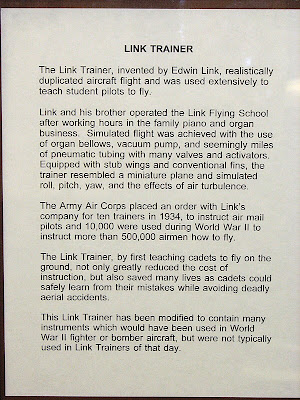
I won't try to explain the history of the Link trainer when the Air Zoo already did it so well (see photo above). Basically it's a small cockpit mock-up with real flight instruments and some pitch-roll-yaw motion to train pilots how to fly without visual reference; i.e. flying just from the instruments. In the photo below you can see me sitting in one at the Air Zoo.

The reason I find these things so cool is because my maternal grandfather (we called him Grampy) used to teach pilots on these simulators! Grampy was in the US Army Air Force during WWII and was assigned to train future pilots. I don't know how he got selected for that - he's wasn't a pilot himself and never had an aviation interest that I'm aware of. My maternal grandmother (aka Grammy) recently dug up his duty records, which showed that he was sent to Indiana or Illinois (I forget which) to be trained in flight instrumentation and celestial navigation. After that he spent time training future pilots.
Interestingly, Grammy was also involved in the war effort as a "Rosie Riveter" - she didn't actually do rivets, but rather she installed hydraulic lines in the nose section of a bomber aircraft, but I don't know which model. Grammy has registered Grampy at the National World War II Memorial (a great site to check out sometime).
FYI, my paternal grandparents - we simply called them Grandpa and Grandma - were also involved in WWII. Grandpa was in the US Navy a diesel engine mechanic on board a landing ship, an LST I believe. Grandma worked at a factory assembling ailerons or artillery shells.

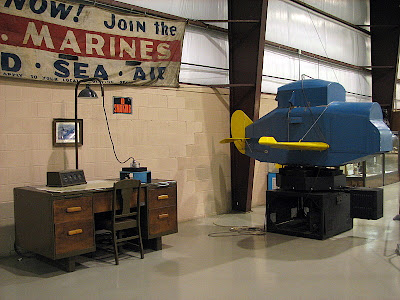
In these next two photos (above and below) you can see a more complete Link trainer than the one I sat in. The complete one has a hood on top to complete enclose the cockpit, giving the pilot zero reference to the outside world which simulates flying in the clouds or total darkness (real Link trainers didn't have a window like this museum piece has). There's also a gimbal mechanism as the base, which can move the cockpit to simulate the motions caused by various control inputs and simulation conditions (e.g. engine out or turbulence).

Particularly interesting to me, the Air Zoo had an instructor's station for the Link simulator. This is where I assume Grampy would've sat when teaching the student pilots! Unfortunately we didn't get a better photo of the desk. On the right side of the desk is a data recorder which kept track of the student's actions during the simulated flight. On the left side are some flight instruments that show the same values as what the student is seeing on the same instruments in the cockpit. On top of the desk (you can't really see it in the photo) is an aeronautical chart where the instructor could plan simulated missions and track the student's progress.
It's always so fun and enlightening to take a walk through history, especially when there's a personal connection.